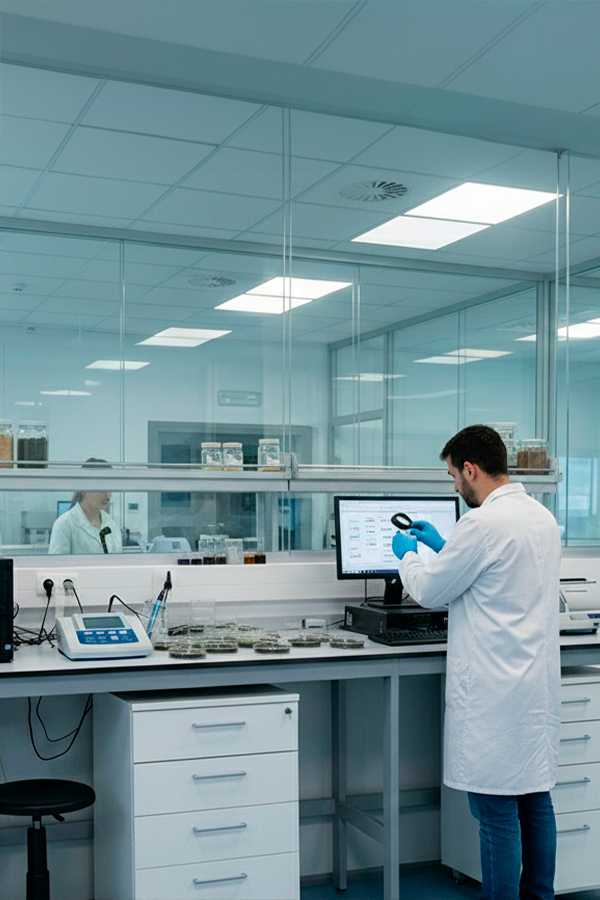
Equipped Laboratory
Equipped Laboratory
At the lab, we have the necessary equipment to perform basic analyses related to the biogeochemistry and functioning of soils.
BMG Fluostar microplate reader. This reader is equipped with absorbance monochromator, which allows us to quantify nutrients such as nitrate, ammonium and phosphate, and dissolved organic carbon in soil and water samples, as well as DNA concentrations. The microplate reader is also equipped with a filter-based florescence reader that allows us to carry out enzymatic assays. Measuring enzymes is particularly important in our lab, as they represent a key soil health indicator given their involvement in the processing of soil organic matter by microbes.
Automatic sieves. Sieving through a 2-mm mesh is a basic step prior to many biological and physicochemical assays involving soils. Moreover, sieving through a set of screens of decreasing mesh size allows us to understand the particle size distribution of a given soil (up to silt and clay combined [0.45 microns], hence allowing us to understand the basic functioning of soils. This is because particle size and pore space greatly determine the ability of soils to retain nutrients, the structure of soil microbial and faunal communities, as well as the ability of roots to grow. Wet sieving can also be used to determine the stability of soil aggregates, critical for soil functioning and carbon storage.
pH meter. Despite being one of the most basic parameters that one can measure in the lab, pH remains to be of enormous interest for soil scientists as a driving variable of soil activity, nutrient solubility, and mineral formation and structure. The pH of a soil represents the negative natural logarithm of proton concentration and is thus linked to the presence or absence of dissolved cations in the soil solution. Our pH meter is also capable of measuring other important soil parameters such as conductivity, salinity and ORP.
Berlesse-Tulgren funnels. These are a basic equipment for the extraction and subsequent determination of soil fauna. Important groups that can be extracted using Berlesse-Tulgren funnels are collembolans (also known as springtails), acari (mites), and some nematodes. We have a custom-made shelf equipped with 24 lamps that allows us to extract several samples simultaneously.